
c.1930s Japanese All-Bisque Flapper-Style Doll
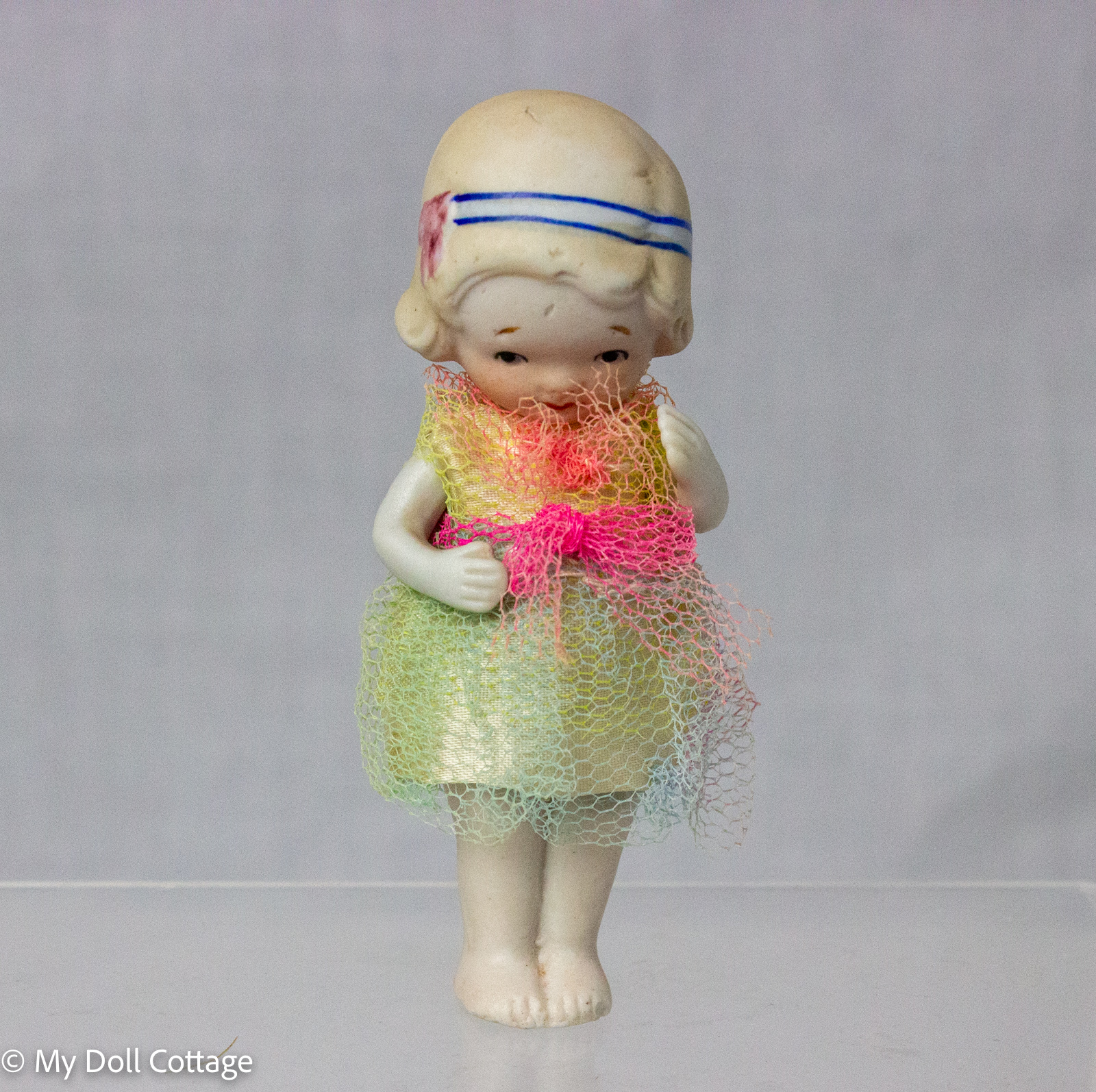
A charming c.1930s Japanese all-bisque miniature girl doll with moulded bobbed hair, painted facial features, moveable arms and a colourful satin and tulle costume.
This smallall-bisque doll measures approximately 120 × 50 × 40 mm (4¾ inches high) and is believed to have been manufactured in Japan during the 1920s–1930s, most likely c.1930s.
The doll is formed principally as a single bisque piece incorporating the head, torso andlegs, with separately made moveable bisque arms. This construction is characteristic of the inexpensive small Japanese bisque dolls exported in considerable numbers during the inter war period. Comparable Japanese examples are found with moulded hair, painted faces and swivel or wire-jointed arms.
Her appearance reflects the fashionable styles of the late 1920s and early 1930s. She has moulded pale-blonde bobbed hair decorated with two hand-painted bluebands and a pink flower at the side. Her delicately painted face hasside-glancing dark eyes, fine brows, rosy cheeks and a small red mouth. Dolls of this general type are frequently described by collectors as flapper-style dolls, although this is a modern descriptive term rather than necessarily the manufacturer's original name. Comparable Japanese flapper-style bisque dolls are dated broadly to the 1920s and 1930s.
The doll retains a particularly attractive period costume consisting of pale yellow-green satin covered with fine pastel tulle or netting in shades of green, yellow and pink. Bright pink netting is tied around the waist and additional pink and peach netting forms a decorative collar or scarf around the shoulders. The survival of these fragile textile elements adds considerable interest to the doll.
No manufacturer's or country-of-origin mark is visible. While many comparable export dolls are impressed or stamped “Japan” or “Made in Japan”,unmarked examples are also encountered. Without a surviving mark, the individual manufacturer cannot presently be identified. Numerous Japanese firms produced and exported bisque dolls during this period, so it would not be appropriate to attribute this example to a particular maker without further evidence.
The attribution to Japan is consistent with the doll's construction, painting, moulded hairstyle and overall form, but should be recorded as attributed to Japan rather than definitively manufacturer-confirmed.
Features
Measurements: 120× 50 × 40 mm (4¾ inches high)
Condition: excellent
Markings:
Date Note: Date is an estimate based on available research and stylistic features. If you have additional information, please contact us to help update our records.
Made from the following materials

Additional Product Images


Related Dolls and Toys from our collection


