
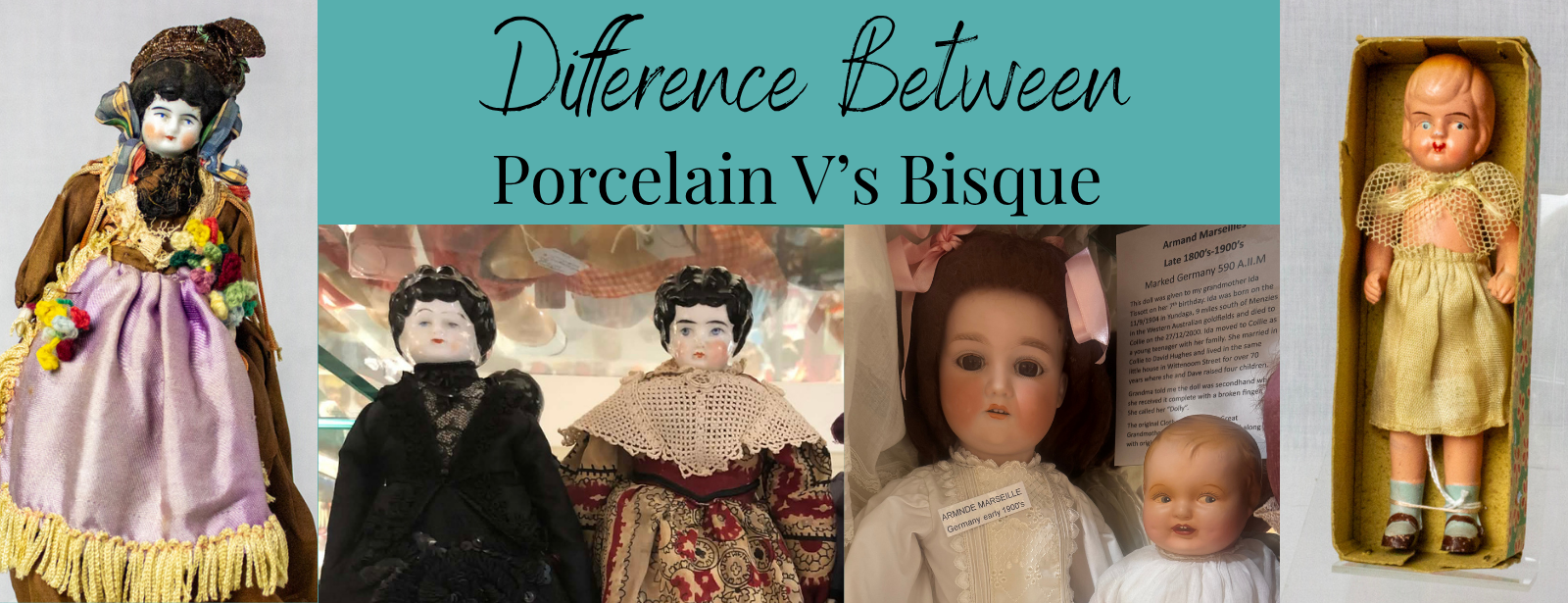
These terms are often used interchangeably, but they describe distinct finishes within the same material. Understanding the difference is essential for accurate identification, cataloguing, and valuation. Both forms represent key stages in the development of European dollmaking.
The following outlines their origins, material differences, and practical implications for collectors and documentation.
Porcelain originated in China over a thousand years ago and was highly valued for its strength, translucency, and refined finish. Known in Europe as “china,” it was imported for centuries before European manufacturers successfully replicated its production.
By the mid-18th century, porcelain manufacturing had been established in Germany and France. Dollmakers began using the material to produce more refined figures, replacing earlier wax, wooden, and cloth dolls. Many early doll producers were already operating within the ceramic and fine china industries.
These dolls were made from glazed porcelain, resulting in a smooth, hard, reflective surface. Early forms, commonly referred to as china dolls, typically feature moulded and painted hair, stylised facial features, and a consistent high-gloss finish.
Porcelain dolls remained in production through the early to mid-1800s. Due to their cost and fragility, they were generally associated with decorative use or ownership within higher-income households.

By the mid to late 19th century, demand shifted towards greater realism. This led to the development of bisque—an unglazed form of porcelain.
Bisque is fired twice. The first firing creates the form, while the second firing sets the painted surface. Without glaze, the material retains a matte finish that more closely resembles human skin.
French manufacturers, including Jumeau, Bru, and Gaultier, refined this technique. Their dolls incorporated glass eyes, applied wigs, and more detailed modelling, significantly increasing realism compared to earlier china dolls.
By the late 1800s, bisque had become the preferred material for high-quality dolls, particularly in the French and German markets.
Both bisque and porcelain are made from the same base material. The defining difference is the surface finish:
* Porcelain dolls are glazed, producing a smooth, reflective surface.
* Bisque dolls are unglazed, resulting in a matte, non-reflective finish.
For identification purposes:
Glaze (shiny) = porcelain (china)
No glaze (matt) = bisque
All bisque is porcelain, but not all porcelain is bisque.

Porcelain (China Dolls):
Bisque Dolls:
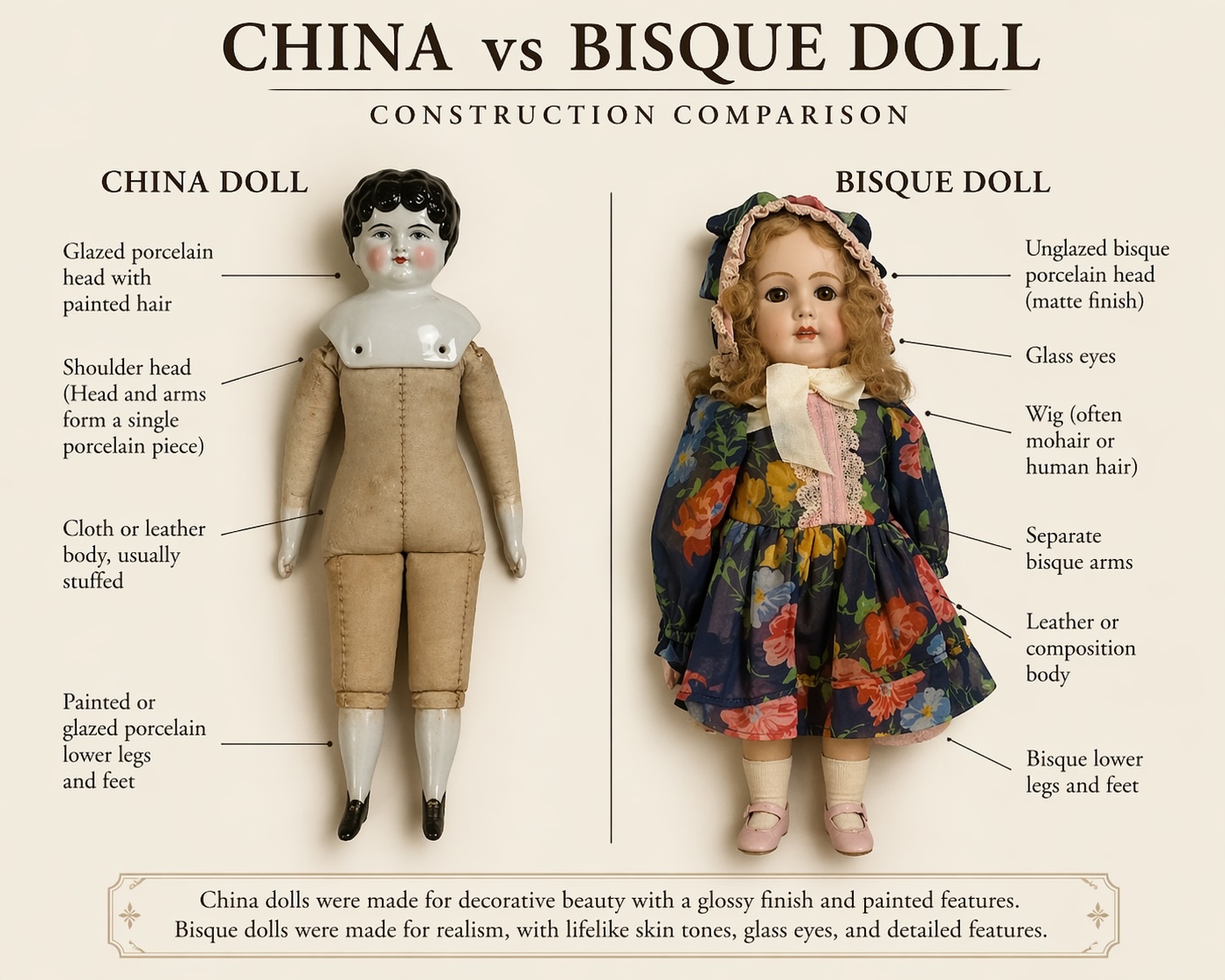
Porcelain (china) was widely used for earlier dolls where durability of surface and decorative appearance were prioritised over realism. These are most commonly seen in mid-19th century dolls with cloth or leather bodies.
Bisque became dominant as manufacturing shifted towards realism. It was used extensively for child dolls, fashion dolls, and character dolls from the late 1800s through the early 1900s.
The transition from glazed porcelain to bisque reflects a broader change in design intent—from stylised representation to lifelike reproduction.

.
The distinction between bisque and porcelain is subtle but significant. Porcelain’s glaze gives it a polished charm, while bisque’s matte finish captures the warmth and realism that made 19th-century dolls so beloved.
Whether you’re drawn to the elegant shine of porcelain or the soft beauty of bisque, both represent a fascinating chapter in dollmaking history—each with its own story to tell.
With love
Shyloh
Tales from the youngest daughter of a doll collector — raised on Milo, Vegemite, and more antiques than a country op shop.