For many Western Australians today, fireworks are something we watch rather than something we buy. They belong to organised displays at festivals, New Year's Eve celebrations and community events, safely handled by licensed professionals.
But within living memory, things were very different.
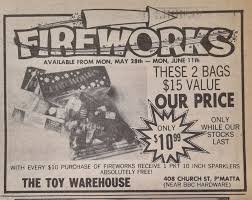
Until the late 1960s, Western Australian families could purchase fireworks from shops for their own celebrations. Crackers, rockets and Catherine wheels were part of childhood for generations of Western Australians, particularly around Guy Fawkes Night on 5 November.
For anyone who grew up after the practice disappeared, it can be difficult to imagine children being given fireworks to let off at home.
Yet old fireworks and their packaging preserved in collections such as My Doll Cottage provide a fascinating reminder of this almost-forgotten part of Australian childhood.

Guy Fawkes Night originated in Britain following the failed Gunpowder Plot of 1605, when a group of conspirators attempted to blow up the Houses of Parliament.
Guy Fawkes was discovered guarding explosives placed beneath the building on 5 November 1605. The failure of the plot subsequently became an annual commemoration, traditionally marked by bonfires, effigies and eventually fireworks.
British settlers carried the tradition with them around the world, including to Australia.
By the twentieth century, Guy Fawkes Night — also commonly called Bonfire Night or simply Cracker Night — had become less about the events of 1605 and more of a community and childhood celebration.
Western Australia was no exception.

For generations of Western Australian children, early November could mean bonfires and fireworks.
Western Australian oral histories preserve memories of families and neighbourhoods building bonfires and setting off crackers and rockets. One State Library of Western Australia interviewee remembered Guy Fawkes celebrations involving a bonfire, crackers and rockets — and also recalled nearly losing an eye when a firework exploded close to his face.
Another Western Australian oral history records childhood memories of building bonfires for Guy Fawkes Night, demonstrating how firmly the tradition had become part of local childhood culture.
Local history collections also preserve memories of Guy Fawkes Night, check out the article and video on the City of South Perth, where residents recalled the fireworks, friendships, rituals and dangers associated with the annual celebration.
These weren't necessarily large organised displays.
Celebrations ranged from family and neighbourhood gatherings to larger community events, with bonfires and privately purchased fireworks forming part of the tradition.
See the full interview from the City of South Perth here
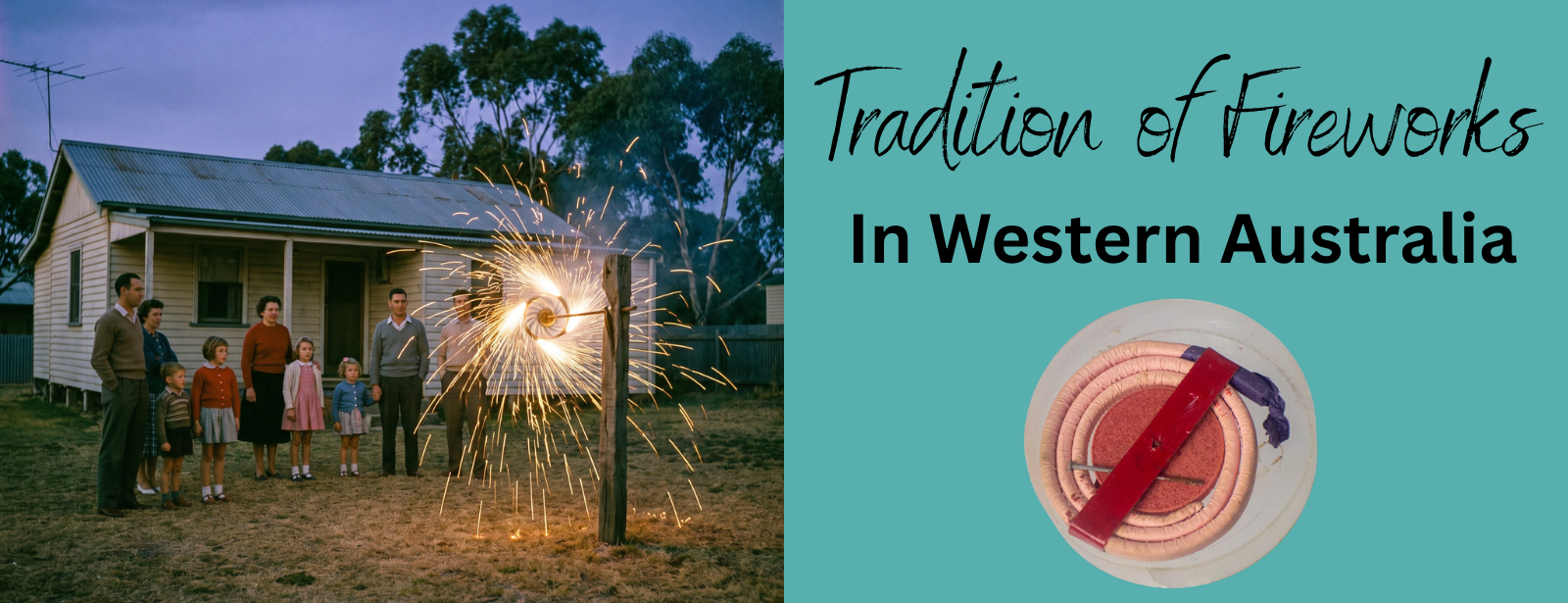
One of the familiar fireworks of the period was the Catherine wheel.
Unlike a rocket, which travelled into the air, a Catherine wheel was designed to be fixed in position. When lit, its jets caused the circular firework to rotate rapidly, creating a spinning display of sparks and coloured light.
For children growing up with Guy Fawkes Night, names such as Catherine wheels, crackers and rockets were simply part of the vocabulary of the occasion.
Today, surviving fireworks packaging can seem rather extraordinary. Fireworks were sold in colourful packaging with memorable names, including Catherine wheels, crackers and rockets, as manufacturers competed for the seasonal Guy Fawkes trade.
But attitudes towards their safety were beginning to change.
By the 1960s, the dangers associated with private fireworks were attracting increasing attention in Western Australia.
This wasn't simply a modern reassessment of an old practice. The concerns were being raised at the time.
In November 1960, the Western Australian Parliament discussed serious accidents involving children and property damage caused by fireworks. A question was put to the government asking whether legislation should be considered to end what was described as a dangerous Guy Fawkes practice.
The childhood memories preserved in WA's oral histories help explain those concerns. Burns and other injuries could occur when children handled fireworks themselves, and eye injuries were a particular danger.
Eventually, Western Australia acted.
In 1967, Western Australia moved to end the ordinary retail sale of fireworks, while retaining authorised public displays.
The parliamentary debate from 4 October 1967 is particularly interesting because it captures the moment the change was taking place.
The government made it clear that the legislation was intended to ban the sale of fireworks in shops while allowing authorised public displays. The minister also acknowledged that the traditional Guy Fawkes celebration, as Western Australians had known it, would effectively come to an end. The stated motivation behind the change was preventing injuries, particularly those suffered by children.
The legislation also created a practical problem for businesses holding stocks of fireworks they would soon be unable to sell. Parliamentary debate later that month discussed suppliers left with stock and the possibility of compensation.
It marked an enormous change in an established childhood tradition.
Within a generation, buying a box of fireworks for Guy Fawkes Night went from an ordinary seasonal activity to something Western Australian children simply didn't experience.
This is one of the things that makes everyday objects so valuable to a social-history collection.
A Catherine wheel may appear to be a very small object. But it represents something much larger.
For an older Western Australian visitor, seeing one may immediately bring back memories of bonfires, crackers, neighbourhood gatherings and childhood excitement.
For someone born after the changes of the 1960s, those experiences can sound almost unbelievable.
The tradition didn't disappear because children suddenly lost interest in fireworks. Attitudes towards acceptable risk were changing. Doctors, hospitals, parents and parliamentarians were increasingly drawing attention to burns, eye injuries and fire danger, and legislation eventually changed with them. A familiar part of Western Australian childhood gradually disappeared.
Today, the general public cannot simply purchase and use ordinary fireworks in Western Australia.
Fireworks are regulated as explosives and generally may only be handled and used by appropriately licensed people. Some low-risk items, including sparklers, party poppers, Christmas crackers, bon-bons and throwdowns, remain unrestricted.
So while Western Australians still enjoy spectacular fireworks displays, the experience is very different from that of earlier generations.
Children can watch the show.
They just aren't standing in the backyard lighting the Catherine wheel themselves.
At My Doll Cottage, we preserve dolls and toys, but we also preserve the everyday objects that help tell the story of childhood.
An old Catherine wheel is one of those objects.
It reminds us that childhood isn't static. The things children played with, the freedoms they were given and even society's ideas about what was considered an acceptable childhood risk have changed enormously.
Something once sold over the counter and eagerly taken home for Guy Fawkes Night is now an object from a world many Western Australians have never personally known.
And that is precisely why seemingly ordinary objects are worth preserving.
With love
Shyloh
Tales from the youngest daughter of adoll collector — raised on Milo, Vegemite, and more antiques than a country opshop.